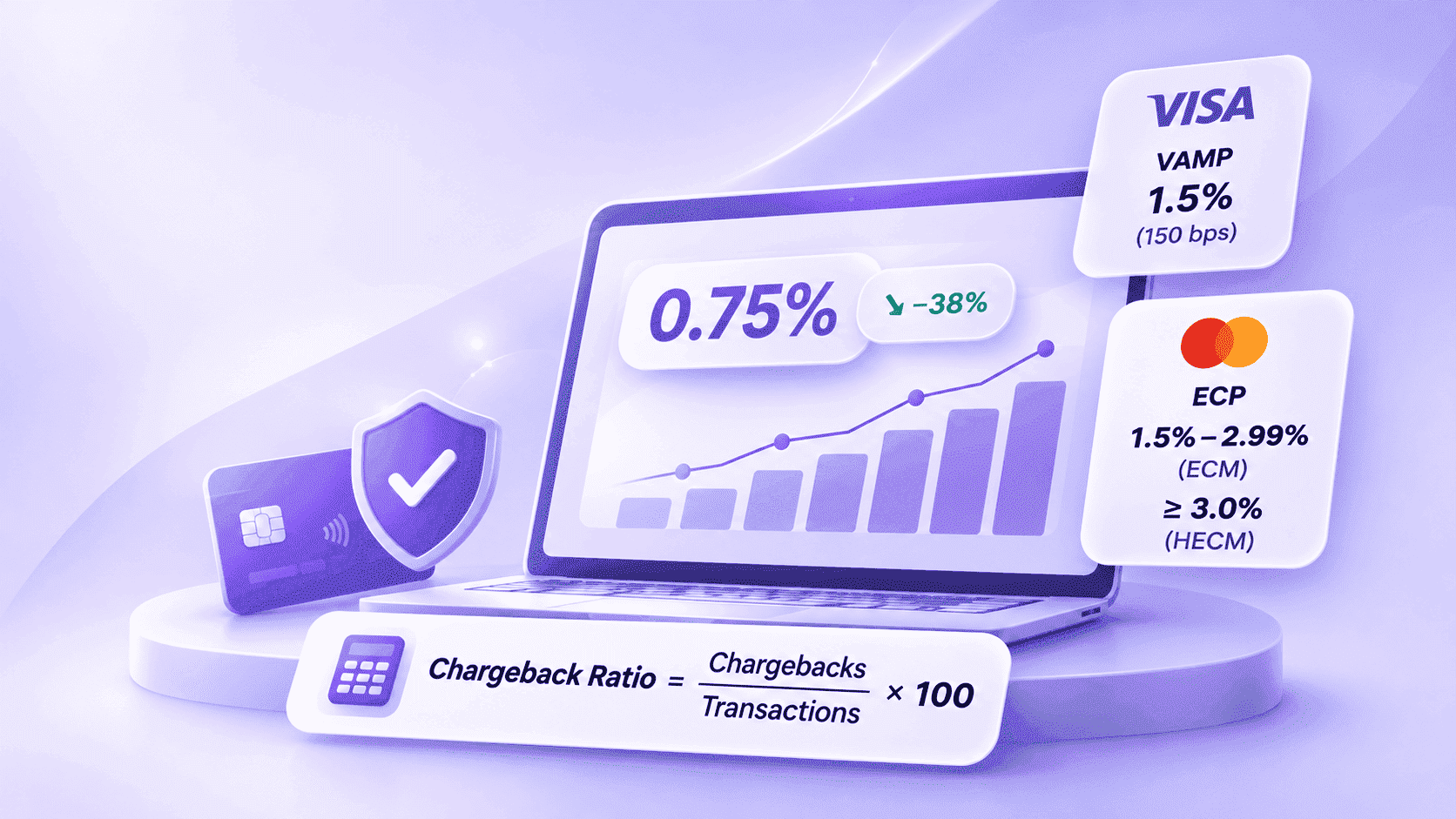
A chargeback ratio measures how frequently payment transactions result in chargebacks. For merchants, it is an important risk indicator because rising dispute activity can increase operational costs, attract closer attention from payment providers, and, in some cases, lead to card-network monitoring.
The basic merchant formula is simple: divide the number of chargebacks by the number of transactions and convert the result to a percentage. However, this calculation should not be confused with the formulas used by Visa and Mastercard monitoring programs. In 2026, the two networks use different inputs, measurement periods, and thresholds.
This guide explains how to calculate chargeback ratio, what an acceptable chargeback ratio means in practice, how Visa VAMP and Mastercard ECP differ, and how merchants can monitor and reduce chargeback risk.
What Is a Chargeback Ratio?
A chargeback ratio is the share of transactions associated with chargebacks over a defined measurement period. Merchants often use it as an internal key performance indicator (KPI) to understand whether dispute activity is increasing or decreasing.
For a general internal calculation, the formula is:
Chargeback Ratio (%) = (Number of Chargebacks ÷ Number of Transactions) × 100
This formula is useful for management reporting, but it is not a universal card-network formula.
Mastercard measures its Excessive Chargeback Program (ECP) ratio using current-month chargebacks against the previous month’s Mastercard transactions. Visa’s Acquirer Monitoring Program (VAMP), meanwhile, combines qualifying fraud reports and disputes against settled card-not-present Visa transactions.
Merchants should therefore monitor at least two layers of performance:
- Internal chargeback ratio: A general KPI used to evaluate dispute trends across payment transactions.
- Network-specific monitoring metrics: The calculations used by Visa, Mastercard, acquirers, and payment processors to assess merchant risk.
Understanding the difference helps merchants avoid relying on a single percentage that may not accurately reflect their exposure to card-network monitoring programs.
How to Calculate Your Chargeback Ratio
For internal reporting, start with the number of transactions and chargebacks recorded during the same reporting period, unless your payment processor or card network requires a different methodology.
The standard internal chargeback ratio calculation follows three steps:
- Determine the total number of chargebacks recorded during the reporting period.
- Determine the total number of transactions included in the calculation.
- Divide the chargeback count by the transaction count and multiply the result by 100.
Chargeback Ratio Calculation Example
Assume an online merchant processed 10,000 transactions during a month and received 75 chargebacks.
Step 1: Divide chargebacks by transactions.
75 ÷ 10,000 = 0.0075
Step 2: Convert the result into a percentage.
0.0075 × 100 = 0.75%
Result: The merchant’s internal chargeback ratio is 0.75%.
This is a simplified management KPI, not a Visa VAMP or Mastercard ECP calculation. Those programs apply their own counting rules and measurement periods.
Chargeback Ratio Calculation Examples
The following examples illustrate how transaction volume and chargeback count affect the resulting percentage.
| Transactions | Chargebacks | Calculation | Chargeback Ratio |
|---|---|---|---|
| 10,000 | 25 | 25 ÷ 10,000 × 100 | 0.25% |
| 10,000 | 75 | 75 ÷ 10,000 × 100 | 0.75% |
| 10,000 | 150 | 150 ÷ 10,000 × 100 | 1.50% |
| 25,000 | 200 | 200 ÷ 25,000 × 100 | 0.80% |
Table 1. Illustrative chargeback ratio calculations for internal merchant reporting.
These examples demonstrate why merchants should evaluate both the percentage and the absolute number of disputes. A business with a relatively low ratio may still have a substantial number of chargebacks, while a smaller merchant may experience significant percentage fluctuations after only a few additional disputes.
How to Calculate Chargeback Ratio in Excel or Google Sheets
You can calculate your chargeback ratio in Excel or Google Sheets without specialized software.
Assume:
- Cell B2 contains the total number of transactions.
- Cell C2 contains the total number of chargebacks.
Enter the following formula in another cell:
=IFERROR(C2/B2,0)Format the result as a percentage.
For example, if B2 contains 10,000 and C2 contains 75, the formula returns 0.75% when the cell uses percentage formatting.
The IFERROR function prevents a spreadsheet error if the transaction count is zero. However, a zero-transaction period should generally be reviewed separately rather than interpreted as a meaningful 0% chargeback ratio.
For more detailed monitoring, consider adding separate columns for:
- Visa and Mastercard transactions.
- Payment processor or acquiring bank.
- Transaction month.
- Chargeback-received month.
- Dispute reason code.
- Country or region.
- Subscription plan or product category.
This approach helps identify network-specific increases that may be hidden within a blended merchant chargeback ratio.
Chargeback Ratio vs. Chargeback-to-Sales Ratio
The terms chargeback ratio, chargeback-to-sales ratio, and chargeback-to-transaction ratio are sometimes used interchangeably.
However, merchants should verify how a particular payment provider defines the word “sales.”
Some reporting systems use the number of transactions, while others may discuss the monetary value of disputed transactions.
These measurements answer different questions:
- Count-based chargeback ratio: How many transactions resulted in chargebacks?
- Value-based chargeback rate: What proportion of transaction value is associated with chargebacks?
Mastercard’s ECP calculation is count-based, not dollar-based. Visa VAMP is also count-based, although its numerator includes qualifying fraud reports as well as disputes.
When comparing reports from different providers, confirm that the numerator, denominator, and reporting periods are consistent.
What Is an Acceptable Chargeback Ratio?
There is no single universally acceptable chargeback ratio for every merchant.
A ratio that appears manageable in an internal report may still approach a payment processor’s risk limits. Card networks also apply different formulas, minimum event counts, and regional conditions.
For example, Visa’s VAMP monitoring metric differs substantially from Mastercard’s ECP methodology. As a result, a merchant cannot use one generic percentage to determine compliance with both programs.
Merchants should avoid treating historical rules of thumb, such as staying below 1%, as universal current card-network requirements.
Instead, a practical risk-management strategy is to:
- Understand the thresholds communicated by each payment processor and acquiring bank.
- Monitor Visa and Mastercard metrics separately.
- Establish internal warning levels comfortably below applicable limits.
- Investigate upward trends before formal monitoring thresholds are reached.
- Review both dispute counts and percentages.
An acceptable chargeback ratio is therefore best understood as a level of dispute activity that remains within the requirements of the relevant payment partners while supporting sustainable payment operations.
Visa and Mastercard Chargeback Ratio Thresholds
Visa and Mastercard use different approaches to merchant dispute monitoring.
In 2026, the most important distinction is that Visa VAMP is not simply a traditional chargeback ratio.
Visa VAMP and Dispute Monitoring
The Visa Acquirer Monitoring Program (VAMP) combines qualifying fraud reports and disputes into a single count-based monitoring metric.
The simplified VAMP formula is:
VAMP Ratio = (TC40 Fraud Reports + TC15 Disputes) ÷ TC05 Settled Card-Not-Present Transactions
To express the result as a percentage, multiply by 100. To express it in basis points, multiply by 10,000.
Visa’s methodology differs from a standard chargeback ratio because the numerator includes qualifying fraud reports in addition to disputes.
Visa also specifies exclusions for certain events.
For example, qualifying disputes resolved through pre-dispute solutions may be excluded from the VAMP numerator. Certain qualifying fraud reports associated with Compelling Evidence 3.0 may also be excluded, depending on the applicable program rules and data-extract timing.
According to Visa’s published VAMP documentation, the Excessive Merchant threshold for the United States, Canada, European Union, and Asia-Pacific became 150 basis points (1.5%) on April 1, 2026, down from 220 basis points.
The merchant-level threshold also includes a minimum monthly combined fraud-and-dispute count of 1,500 events, and merchant identification is subject to additional program conditions, including the relevant acquirer-level condition.
These requirements should not be interpreted as a universal 1.5% chargeback threshold for every Visa merchant worldwide.
Because VAMP uses specific VisaNet event types, a merchant cannot reliably determine its VAMP position from a basic chargeback dashboard alone.
Mastercard Chargeback Monitoring
Mastercard’s Excessive Chargeback Program (ECP) uses a different calculation methodology.
According to Mastercard’s Security Rules and Procedures — Merchant Edition, dated August 4, 2026, the ECP ratio is calculated as:
Mastercard ECP Ratio (bps) = (Current-Month Mastercard Chargebacks ÷ Previous-Month Mastercard Transactions) × 10,000
The important difference is the measurement period.
Mastercard compares chargebacks received during the current calendar month with Mastercard transactions acquired during the preceding calendar month.
This means the Mastercard monitoring ratio can differ from a merchant’s internal same-month chargeback calculation even when both use the same underlying payment activity.
Mastercard identifies two relevant monitoring categories:
- Excessive Chargeback Merchant (ECM).
- High Excessive Chargeback Merchant (HECM).
Mastercard’s publicly accessible August 2026 Merchant Edition confirms the program structure and calculation methodology but directs readers to separate program documentation for the exact numerical thresholds.
Current documentation from major payment providers, including Nuvei, Adyen, and Braintree, reports the following thresholds:
- ECM: 100–299 chargebacks and a ratio from 1.5% to 2.99%.
- HECM: 300 or more chargebacks and a ratio of at least 3.0%.
These numerical thresholds are corroborated by payment processor documentation rather than independently verified from the publicly accessible Mastercard Merchant Edition reviewed for this article.
Merchants should confirm the current requirements with their acquiring bank or payment processor.
Visa vs. Mastercard: Key Monitoring Differences
The following table summarizes the relevant differences between Visa VAMP and Mastercard ECP.
| Network | Program | Calculation | Reported Threshold | Verification |
|---|---|---|---|---|
| Visa | VAMP Excessive Merchant | TC40 fraud reports + TC15 disputes ÷ settled CNP TC05 transactions | 1.5% (150 bps) and at least 1,500 monthly combined events for the U.S., Canada, EU, and Asia-Pacific, subject to program conditions | Verified through Visa’s public documentation; threshold effective April 1, 2026 |
| Mastercard | ECP — ECM | Current-month chargebacks ÷ previous-month Mastercard transactions | 1.5%–2.99% and 100–299 chargebacks | Threshold corroborated by processor documentation |
| Mastercard | ECP — HECM | Current-month chargebacks ÷ previous-month Mastercard transactions | 3.0% or higher and at least 300 chargebacks | Threshold corroborated by processor documentation |
Table 2. Visa and Mastercard merchant monitoring methodologies and reported thresholds as of November 2026.
Key takeaway: Visa VAMP and Mastercard ECP should be monitored separately. Their ratios use different inputs, and neither should be replaced with a generic internal chargeback-to-sales ratio.
What Happens When Your Chargeback Ratio Is Too High?
A high chargeback ratio can create operational and financial risks for merchants.
Card networks may identify merchants or acquirers under monitoring programs, while payment processors and acquiring banks may apply their own risk-management requirements.
Depending on the circumstances, potential consequences include:
- Additional monitoring: Closer review of dispute activity and merchant risk.
- Remediation requirements: Requests to implement corrective measures or submit an improvement plan.
- Additional fees or assessments: Charges associated with applicable monitoring programs or contractual arrangements.
- Reserve requirements: Funds held by a processor or acquirer to manage potential financial exposure.
- Processing restrictions: Limits on transaction volume or payment processing activity.
- Merchant account termination: Potential loss of processing services in serious or persistent cases.
These outcomes are not determined by the ratio alone.
Transaction volume, chargeback count, fraud activity, business model, acquiring bank policies, and the duration of elevated dispute activity can all influence how a merchant is assessed.
For this reason, merchants should investigate increasing dispute activity before it reaches a formal monitoring threshold.
How to Monitor Your Chargeback Ratio
Effective chargeback monitoring requires more than checking one percentage at the end of each month.
Merchants should establish a repeatable process that combines transaction data, dispute information, and network-specific monitoring requirements.
Merchant Chargeback Monitoring Checklist
- Track transaction and chargeback counts. Record monthly transaction volumes and chargebacks received.
- Separate payment networks. Monitor Visa and Mastercard activity independently.
- Distinguish reporting periods. Keep transaction months separate from chargeback-received months.
- Track Visa VAMP inputs. Obtain relevant fraud-report and dispute information where available.
- Establish internal warning levels. Set operational alerts below applicable processor and network thresholds.
- Analyze dispute patterns. Review reason codes, products, subscription plans, countries, issuers, and payment providers.
- Investigate sudden increases. Identify unusual changes before the end of the monitoring month.
- Monitor absolute counts. Review the number of disputes alongside the percentage because some programs require both.
For businesses processing large transaction volumes, weekly or daily operational reviews may provide earlier visibility into emerging problems.
Merchants should also remember that Mastercard’s ECP uses the previous month’s transaction denominator, while Visa VAMP relies on its own VisaNet event categories.
These differences make network-specific reporting particularly important.
Tools that consolidate dispute information can support this process. For example, Disputeur’s chargeback analytics and dispute insights help merchants review dispute activity, identify trends, and examine available breakdowns by issuing bank, currency, and transaction amount.
How to Reduce Your Chargeback Ratio
Learning how to reduce chargeback ratio starts with understanding why customers dispute transactions.
The most effective approach is to identify recurring causes and address them before additional disputes occur.
1. Improve Billing Transparency
Customers may dispute transactions they do not recognize or understand.
Use recognizable billing descriptors, clear checkout language, accurate product descriptions, transparent pricing, and visible renewal terms.
Make sure customers understand:
- Which company is charging them.
- What product or service they purchased.
- When recurring payments will occur.
- How to contact customer support.
- How to request a refund or cancel a subscription.
Clear communication can reduce confusion and help prevent avoidable disputes.
2. Strengthen Fraud Prevention
Unauthorized transactions can contribute to fraud-related disputes and chargeback activity.
Merchants should use appropriate fraud controls based on transaction risk, geography, device signals, authentication requirements, and available payment-provider capabilities.
Depending on the business model, these controls may include transaction monitoring, risk-based authentication, and additional verification for suspicious payments.
No fraud prevention system eliminates every fraudulent transaction. However, identifying higher-risk activity before payment completion can help reduce exposure.
3. Improve Customer Support and Refund Processes
Customers sometimes contact their issuing bank because they cannot resolve a problem directly with the merchant.
Make support channels and refund policies easy to find.
Respond promptly to complaints about:
- Incorrect charges.
- Undelivered products.
- Service interruptions.
- Duplicate transactions.
- Cancellation problems.
- Unexpected recurring payments.
When legitimate customer issues are resolved directly, some disputes may be prevented from escalating into formal chargebacks.
It is also important to understand the difference between refunds and chargebacks. A refund initiated before a dispute is not equivalent to reversing a chargeback that has already been recorded.
4. Reduce Subscription Billing Confusion
Subscription businesses face particular risks when customers forget about recurring payments or misunderstand trial conversion terms.
To reduce subscription-related disputes:
- Clearly disclose recurring billing terms before purchase.
- Communicate renewal dates and pricing changes.
- Explain when free trials convert into paid subscriptions.
- Make cancellation instructions easy to find.
- Send appropriate renewal or billing reminders.
- Provide accessible customer support.
These measures help reduce misunderstandings that may otherwise result in customer complaints or payment disputes.
5. Use Chargeback Alerts and Early Dispute Resolution
Chargeback alerts can provide earlier visibility into eligible payment disputes.
Depending on the alert program, merchants may have an opportunity to review transaction information and take an appropriate action before a formal chargeback progresses.
Potential actions can include reviewing the case, contacting the customer, or issuing an eligible refund in accordance with program requirements.
However, chargeback alerts do not guarantee that every chargeback will be prevented.
It is important to distinguish between:
- Preventing a customer dispute before it occurs.
- Receiving an early dispute alert.
- Resolving an eligible pre-dispute case.
- Refunding a transaction.
- Responding to an existing formal chargeback.
These activities can have different effects on reporting and network monitoring.
Visa specifically states that qualifying disputes resolved through certain pre-dispute solutions may be excluded from the VAMP numerator, depending on applicable rules and data-extract timing.
Merchants should not assume that every alert, refund, or successful dispute response automatically removes an event from Visa or Mastercard monitoring calculations.
6. Monitor Dispute Trends Continuously
Chargeback ratio reduction is an ongoing process rather than a one-time adjustment.
Review dispute data regularly to identify recurring patterns and operational weaknesses.
For example, an increase in disputes linked to a particular subscription plan may indicate unclear renewal communication. A concentration of disputes associated with a specific payment channel may suggest a need to review fraud controls or checkout processes.
Merchants should track:
- Overall chargeback ratio.
- Chargeback count.
- Fraud-report activity.
- Dispute reason codes.
- Payment network.
- Issuing bank.
- Country and currency.
- Product or subscription category.
Analyzing these indicators together can help teams prioritize corrective action.
Chargeback Reduction Strategies at a Glance
| Risk Factor | Recommended Action | Operational Benefit | Metric to Monitor |
|---|---|---|---|
| Unrecognized billing | Improve descriptors and customer communication | Fewer recognition-related disputes | Disputes by reason |
| Fraudulent transactions | Strengthen risk and authentication controls | Lower unauthorized-use exposure | Fraud reports and fraud disputes |
| Slow customer support | Improve support and refund response | More issues resolved before escalation | Refund and dispute trends |
| Subscription confusion | Send renewal reminders and simplify cancellation | Fewer recurring-billing complaints | Subscription-related disputes |
| Late dispute visibility | Use applicable chargeback alerts | More time to review eligible cases | Alert-to-resolution outcomes |
| Recurring operational issues | Analyze dispute trends continuously | Faster root-cause identification | Ratio, count, issuer, currency, and reason |
Table 3. Practical strategies for reducing chargeback exposure and monitoring operational improvements.
How Disputeur Can Help Merchants Manage Chargeback Risk
Managing chargeback risk requires timely information, consistent dispute workflows, and visibility into payment dispute trends.
Disputeur’s chargeback management platform brings chargeback alerts, dispute management, case monitoring, and analytics into a centralized workspace.
Merchants can review incoming dispute information, monitor case statuses and outcomes, and use available dispute insights to identify areas requiring attention.
For businesses looking to reduce chargeback exposure, earlier visibility and consistent monitoring can make it easier to respond to eligible cases and understand where disputes are concentrated.
Disputeur does not replace the official monitoring calculations used by Visa, Mastercard, or payment processors. Instead, it supports the operational processes merchants use to manage payment disputes.
Explore Disputeur’s chargeback management software to see how dispute alerts, case tracking, and analytics can fit into your payment workflow.
Frequently Asked Questions
What is a good chargeback ratio?
There is no universal good chargeback ratio because Visa, Mastercard, processors, and acquiring banks use different methodologies and risk policies. A practical goal is to keep your internal ratio comfortably below the applicable limits communicated by your payment partners and investigate increasing dispute activity before formal monitoring thresholds are reached.
How do you calculate a chargeback ratio?
For a general internal KPI, divide the number of chargebacks by the number of transactions and multiply by 100. For example, 50 chargebacks from 10,000 transactions equals 0.5%. Network calculations can differ because Mastercard and Visa use distinct measurement periods and event categories.
What happens if your chargeback ratio is too high?
A high chargeback ratio may lead to additional processor scrutiny, card-network monitoring, remediation requirements, fees, reserves, processing restrictions, or merchant account termination. The actual consequences depend on the applicable network program, acquiring bank, payment processor, and merchant agreement.
How often should merchants calculate their chargeback ratio?
Merchants should review chargeback performance at least monthly because Visa and Mastercard monitoring operates on monthly measurement cycles. Businesses with higher transaction volumes or elevated dispute activity may benefit from weekly or daily internal monitoring to identify sudden increases earlier.
Is the Visa chargeback ratio calculated differently from Mastercard’s?
Yes. Visa VAMP combines qualifying TC40 fraud reports and TC15 disputes and divides them by settled card-not-present TC05 transactions. Mastercard ECP calculates chargebacks received in the current calendar month against Mastercard transactions acquired during the preceding month. These metrics are not interchangeable.
Can refunds reduce a chargeback ratio?
A normal refund does not retroactively erase a chargeback that has already been counted. However, resolving an eligible customer issue before a formal dispute may prevent some chargebacks from occurring. Visa also excludes certain disputes resolved through qualifying pre-dispute solutions from VAMP, subject to program rules and extract timing.
How can merchants reduce their chargeback ratio?
Start by identifying the main causes of disputes. Improve billing transparency, fraud prevention, customer support, refund processes, and subscription communication. Use early dispute alerts where appropriate, monitor network-specific metrics, and analyze dispute trends continuously to identify and correct recurring operational problems.
Conclusion: Monitor Chargeback Ratios Before They Become a Problem
Your chargeback ratio is an important indicator of payment dispute risk, but it should never be interpreted in isolation.
The basic chargebacks-to-transactions formula provides a useful starting point for internal reporting. However, Visa VAMP and Mastercard ECP use different calculations, measurement periods, and monitoring conditions.
Merchants that understand these differences can establish more reliable monitoring processes, identify dispute trends earlier, and take targeted action to reduce chargeback exposure.
By combining accurate reporting, stronger customer communication, fraud prevention, and timely dispute management, businesses can make more informed decisions about payment risk.
To simplify day-to-day dispute operations, explore how Disputeur helps merchants manage chargeback alerts, track disputes, and gain clearer visibility into payment dispute activity.